
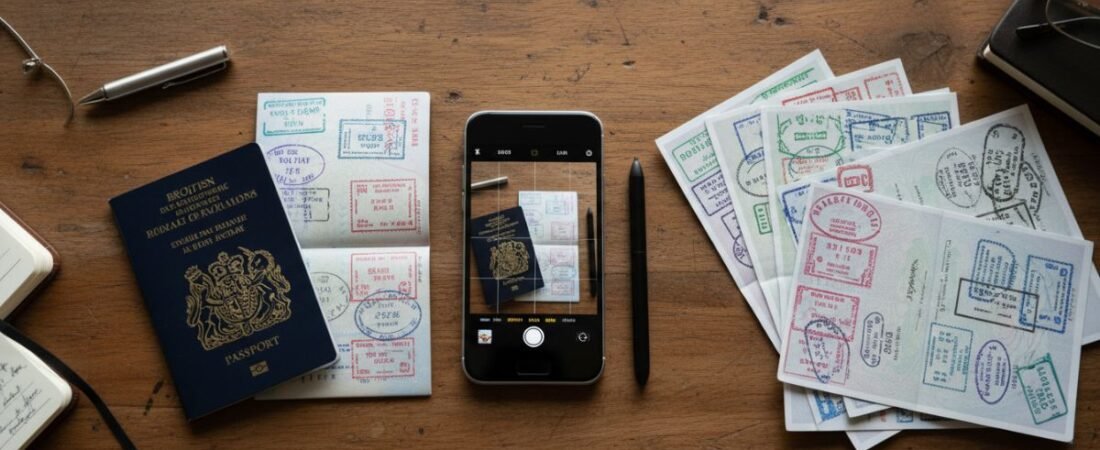
There is a specific kind of quiet dread that settles in when you realize your passport is nearing its expiration date. For those of us navigating life between the red dirt of Australia and the green hills of the UK, that little burgundy or blue book is more than just an ID. It is a certificate of administrative identity. It is the key to our mobility, our family adventures, and our self-sovereignty. Recently, I sat down in Australia to tackle the renewal of my British passport, and while the digital age has brought some welcome conveniences, it has also revealed the expanding reach of the administrative gaze.
The Passport as an Administrative Artifact
To the modern nomad, the passport feels like a tool for freedom. However, from the perspective of the state, it is an instrument of population management. It is part of a long arc of administrative control that began with parish registers and evolved into the sophisticated biometric databases of today. When you initiate a UK passport renewal from Australia, you are not merely updating a travel document; you are re-verifying your existence within a global system designed for throughput and classification.
The system rewards compliance and punishes friction. By understanding the incentives of the HM Passport Office (HMPO), we can better navigate the process without succumbing to the frustration that bureaucratic rigidity often induces. The goal is to remain a sovereign mind while satisfying the requirements of a managed world.
The Biometric Gateway: Efficiency as an Onboarding Tool
Let us start with the technical implementation of the process. If you have ever spent twenty minutes in a humid shopping centre photo booth trying to get a toddler to look at a lens, you will appreciate the new digital photo system. The UK government now allows you to take your passport photo with a smartphone. This is a massive leap forward in practicality, but it also serves a specific institutional incentive: data quality.
The online application portal features a built-in tool that checks your photo in real-time. It tells you if it is too dark, too blurry, or if your expression is a bit too adventurous for their liking. This is the kind of engineering mindset that eliminates human error before it reaches the archive. By standardizing the input at the source, the state ensures that its facial recognition algorithms have the highest possible fidelity. You can find the full technical requirements on the official GOV.UK photo guide, which illustrates the precise geometry the state requires of your face.
The Surveillance Audit: Why Every Page Matters
The most jarring aspect of the modern renewal process for dual citizens is the requirement to provide evidence of other identities. The HMPO instructions are clear: you must send any current or expired passports from other countries that have not been cancelled. You have two choices: send the physical passport or provide a full-colour photocopy of every single page. This includes every visa, every entry stamp, and every blank page in the book.
This is where the mask of “convenience” slips to reveal a data-harvesting operation. From a systems-thinking perspective, why does the UK government need to see a blank page in an Australian passport? The answer lies in the concept of “managed identity.” The state requires a total audit of your movement. By inspecting every stamp, they reconstruct your history of throughput. They are looking for inconsistencies, undisclosed residencies, or patterns of travel that might flag you within their predictive models. This is a “digital enclosure” of your mobility, where your right to travel is contingent upon your willingness to disclose your entire history of international presence.
Throughput and Consistency
This requirement ensures that your identity is consistent across all jurisdictions. In an era where ICAO biometric standards are harmonizing travel documents globally, the “every-page” rule acts as a manual synchronization of databases. It is a way for the UK to verify that the individual they are documenting is the same individual managed by the Australian authorities. For the nomadic family, this is more than just a trip to the scanner (it is an exercise in transparency that most people accept without question).
The Logistics of Dispossession: Fees and Freight
Self-sovereignty is not free, and the state extracts its toll at every gate. When applying for a UK passport renewal from Australia, you are looking at significant costs that reflect the extractive nature of bureaucracy. A standard 34-page passport currently costs £108. If you are a frequent traveller who expects to fill pages with stamps, you might opt for the 54-page version at £121.
Then comes the courier fee. Because you are an overseas resident, the HMPO charges a flat £19.86 to securely send your documents back to you in Australia. In total, a standard renewal will set you back £127.86. It is important to note that they do not accept some prepaid cards, reinforcing the link between your administrative identity and your financial footprint. They require a standard credit or debit card, ensuring the payment itself is a traceable data point.
Shipping Your Identity Overseas
Once the fee is paid, you must entrust your physical identity to the post. You are required to mail your old UK passport and the mountain of photocopies to Hemel Hempstead:
HM Passport Office
INT-DAP, PEX 541 989 376X
Three Cherry Trees Lane
Hemel Hempstead, HP2 7HQ
United Kingdom
Using a tracked and signed-for delivery service is essential. You are essentially putting your primary tool for international movement in a paper bag and sending it 15,000 kilometres away. This period of waiting is a state of administrative limbo, where your ability to cross borders is temporarily suspended by the very system that grants it.
Historical Continuity: From Parish Registers to Digital ID
Citizen Erased views these modern requirements not as new crises, but as the latest iteration of an old impulse. The “every-page” photocopy rule is the digital descendant of the Tudor-era “pass” that laborers were required to carry to move between parishes. Those early records (parish registers, workhouse logs, and administrative surnames) were designed to tidy the population and quantify the workforce. Today, the tools have simply become more precise.
The transition from paper logs to blockchain-ready digital IDs is a move toward automated compliance. When you submit your digital photo and your scanned Australian visas, you are contributing to a dataset that allows for the frictionless management of the population. The state no longer needs to hunt for information; it simply designs systems where the citizen must provide it in exchange for basic rights like travel. This is the essence of the administrative gaze: it makes the individual legible to the system, so the system can better manage the individual as a resource.
The Wait: Timelines and Tracking
The current estimate for receiving your new passport is roughly 4 weeks. This clock starts from the moment the HMPO receives your physical documents, not the moment you hit submit online. If your photocopies are blurry or incomplete, the timeline stretches. This is where the bureaucratic reward for precision becomes evident. A perfectly prepared application moves through the machinery of the INT-DAP (International Digital Application Processing) unit with minimal human intervention.
The tracking system provides a window into this machinery. Using your application reference (e.g., PEX 123 456 789X), you can monitor the status. There is a certain dry satisfaction in seeing the status change from “Documents received” to “Passport printed.” It is the moment the system acknowledges your re-verified status and issues a new ten-year lease on your mobility. For more insights into how these records shape our modern lives, you can explore our research on historical recordkeeping and power.
Strategies for the Sovereign Mind
Renewing a UK passport from Australia is a reminder that we live in a world built around surveillance, classification, and throughput. However, awareness is the first step toward reclaiming agency. By recognizing that these processes are designed for administrative convenience, we can approach them with the necessary precision and a healthy dose of skepticism.
To navigate this friction, consider the following sovereign strategies:
- Maintain a Digital Archive: Keep high-quality scans of all your identity documents in an encrypted environment. When the state asks for “every page,” you should already have it ready.
- Understand the Incentives: The HMPO wants a clean, automated process. Give them exactly what they ask for to minimize their gaze on your life.
- Diversify Your Identity: If you are a dual citizen, ensure both sets of documents are managed with equal care. Your mobility should never depend on a single bureaucratic point of failure.
- Recognize the Narrative: Your passport is a tool for the state to track you, but it is also a tool for you to move. Use it intentionally, while building a life that is less dependent on centralized permission.
The goal is always freedom. The freedom to take your family wherever you choose and to exist as more than just a data point in a government database. Get the application done, send the documents, and then return your focus to the things that actually define you: your relationships, your work, and your sovereign choices. The system can have its photocopies; we will keep our autonomy.


